
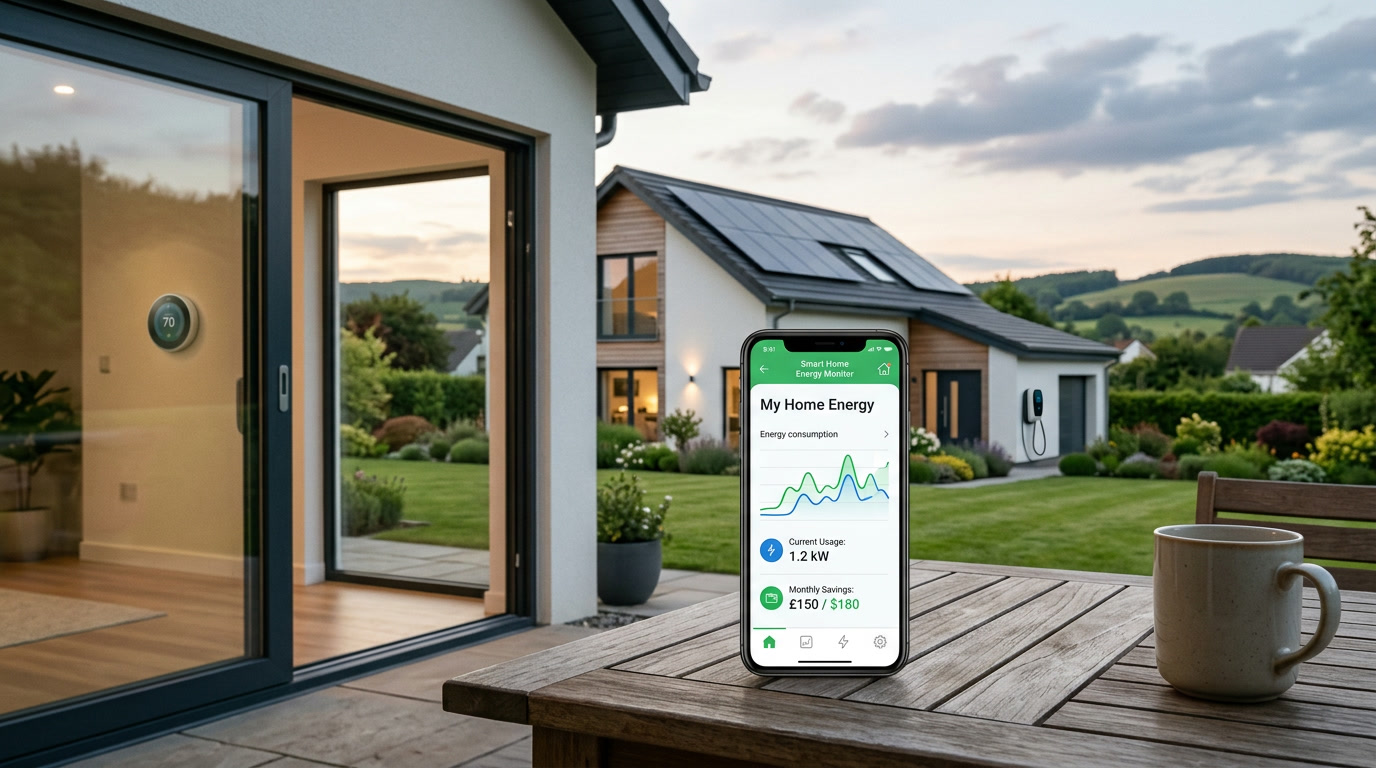
There’s a particular kind of frustration that comes from staring at an electric bill that’s fifty dollars higher than last month with absolutely no idea why. Was it the extra load of laundry? The AC working overtime during that heatwave? An old appliance quietly dying in the garage? Without real data, every explanation is a guess. That’s exactly the problem smart energy monitoring devices solve, and picking the right one can turn a vague monthly mystery into one of the most genuinely useful parts of a smart home solution.
This guide breaks down the best energy monitoring devices available to American homeowners right now, organized by what they’re actually good at, so you can pick based on your specific situation instead of chasing the most expensive option out of habit.
Why Energy Monitoring Deserves Its Own Category
Most smart home devices add convenience — a light that turns on by itself, a lock that opens automatically. Energy monitors are different. They don’t control anything directly; they simply tell the truth about consumption that used to be invisible. That visibility is what makes them uniquely valuable within a broader smart home solution, since informed decisions almost always beat guesswork when it comes to actually lowering a utility bill.
Before comparing specific products, it helps to understand the three general categories these devices fall into, since each serves a different purpose.
Whole-home monitors install at the breaker panel and track total household consumption, often with the ability to break usage down by individual circuits.
Smart plugs with energy monitoring track a single device or appliance plugged into them, offering precise, targeted data without any electrical panel work.
Utility-integrated monitors pull data directly from your electric company’s smart meter, requiring no additional hardware installation at all, though with less granular detail.
Each category has a place, and many well-built energy monitoring setups actually combine more than one.
Best Overall Whole-Home Monitor: Emporia Vue 2
The Emporia Vue 2 has become one of the most recommended whole-home monitors for good reason: it hits a genuinely rare balance of affordability, accuracy, and ease of installation. It clips onto the main power lines at the breaker panel, along with up to sixteen additional circuits depending on the model, giving a detailed breakdown of where electricity is actually going room by room or appliance by appliance.
Setup does require opening the breaker panel, so unless you’re comfortable working near live electrical components, having a licensed electrician handle installation is the safer route. Once running, the Vue 2 integrates smoothly with Home Assistant, either through its cloud API or local options depending on firmware version, making it a strong foundation for a broader smart home solution focused on efficiency.
Best for Full Local Control: IoTaWatt
For homeowners who prioritize privacy and want their energy data to stay entirely on their own network, IoTaWatt is the clear standout. Unlike many competitors that rely on cloud processing, IoTaWatt operates fully locally, logging detailed circuit-level data directly to its own device without needing to phone home to any external server.
It requires a bit more technical comfort to set up compared to plug-and-play competitors, and the interface is more utilitarian than flashy. But for technically inclined users building a smart home solution around local control and data ownership, IoTaWatt remains one of the most respected options in the DIY energy monitoring space.
Best for Appliance Detection: Sense Energy Monitor
Sense takes a genuinely different approach. Rather than requiring individual sensors on every circuit, it uses sophisticated pattern-recognition algorithms to identify specific appliances based on their unique electrical signature — essentially learning to recognize what a refrigerator compressor, a washing machine motor, or an air conditioner sounds like electrically.
The accuracy of this detection improves over time as the system learns your home’s specific devices, though it can take weeks or even months to fully identify everything running on a busy circuit. For homeowners who want detailed appliance-level insight without wiring individual smart plugs to everything, Sense offers a compelling, if occasionally imperfect, solution.
Best Budget Option: Individual Energy-Monitoring Smart Plugs
Not every household needs — or wants to pay for — a full whole-home monitoring system right away. Energy-monitoring smart plugs, available from several reputable brands, offer an affordable, no-panel-work way to start tracking specific high-suspicion devices.
Good candidates for this approach include:
- Older refrigerators or secondary freezers
- Space heaters used during colder months
- Entertainment centers with multiple standby devices
- Washers, dryers, and dishwashers
Buying four or five monitoring smart plugs and placing them on the appliances most likely to be driving up a bill often delivers surprisingly useful insight for a fraction of the cost of whole-home hardware, making it a smart starting point for anyone easing into a broader smart home solution.
Best for Solar Households: SolarEdge and Enphase Monitoring
Homeowners with solar panels have a slightly different set of priorities, since they care as much about production as consumption. SolarEdge and Enphase, two of the most established names in residential solar, both offer strong monitoring ecosystems that track panel-level production, system efficiency, and how much power is being sent back to the grid versus consumed directly.
While these systems are primarily tied to their own solar equipment, both offer integrations that can feed production data into Home Assistant, allowing solar-aware automations — like running major appliances during peak production hours — to become part of a genuinely optimized, cost-conscious smart home solution.
Best for Simplicity: Utility Smart Meter Data
For homeowners who want energy insight without installing any additional hardware at all, many major U.S. utilities now offer smart meter data sharing through programs like Green Button Connect. This data can often be pulled directly into Home Assistant or third-party energy tracking tools, providing daily or even hourly consumption figures without touching the breaker panel.
The tradeoff is granularity — utility data typically shows whole-home consumption without any circuit or appliance-level breakdown. Still, for anyone just wanting a general sense of trends over time, this zero-installation option is worth checking before investing in additional hardware.
Comparing the Options at a Glance
Choosing between these devices really comes down to what specific problem you’re trying to solve:
- Want the most detail with reasonable effort? Emporia Vue 2 offers the best balance of granularity and ease of setup.
- Prioritize privacy and local control above all else? IoTaWatt is the strongest fully local option available.
- Don’t want to wire individual circuits at all? Sense offers appliance-level insight through software-based detection instead.
- Just want to test the waters affordably? A handful of energy-monitoring smart plugs delivers useful data without any panel work.
- Already have solar panels? SolarEdge or Enphase monitoring rounds out the picture alongside consumption data.
- Want zero hardware installation? Utility smart meter data, where available, provides a reasonable starting point.
Many well-optimized households actually end up combining two of these approaches — a whole-home monitor for the big picture, paired with a few smart plugs on specific high-suspicion appliances for added detail.
What to Look for Beyond the Brand Name
Regardless of which device you choose, a few technical factors are worth paying attention to before buying:
Home Assistant compatibility. Confirm there’s an actively maintained integration, rather than a clunky, unofficial workaround that might break with future updates.
Local vs. cloud dependency. Cloud-based systems are often easier to set up but introduce a dependency on the manufacturer’s servers staying online and supported long-term. Local options avoid that risk entirely.
Update frequency. Some monitors report data every few seconds, while others update only every fifteen minutes or so. For automations that need to respond quickly to unusual usage, faster reporting intervals matter.
Installation complexity. Be honest about your own comfort level with electrical work. A device that requires professional installation isn’t a downside if you’re planning to hire an electrician anyway, but it’s worth factoring into your overall budget.
Long-term data ownership. Consider what happens to historical data if the manufacturer changes pricing, discontinues cloud support, or shuts down entirely. Locally logged data avoids this risk altogether.
Turning Data Into Actual Savings
Buying a monitoring device is only the first half of the equation. The real value comes from acting on what the data reveals. A few practical next steps once your monitoring setup is running:
- Identify the top three or four consumption sources and evaluate whether upgrades, repairs, or usage changes make sense
- Set up alerts for unusual spikes, catching problems like a failing appliance before they become expensive
- Shift flexible tasks to off-peak hours if your utility charges time-of-use rates
- Track improvements over time after making changes, confirming that adjustments are actually delivering the expected savings
Without this follow-through, even the most sophisticated monitoring device becomes just an expensive dashboard nobody looks at after the first few weeks.
Final Thoughts
Smart energy monitoring devices solve a genuinely universal problem: not knowing where household electricity actually goes. Whether you choose a detailed whole-home system like the Emporia Vue 2, a fully local option like IoTaWatt, software-based detection through Sense, or simply a few affordable smart plugs on suspect appliances, the right choice depends far more on your specific goals than on chasing the flashiest product on the market.
For anyone building a genuinely effective smart home solution, energy monitoring deserves a place near the top of the priority list — not because it controls anything directly, but because it turns one of the most confusing parts of homeownership into something clear, measurable, and ultimately something you can actually do something about.